9 min read · updated 2026-05-26
Shed, studio, JADU, or full ADU? A California buyer's framework
Four ways to add a small structure in your California backyard. Which one matches your goal — rental income, home office, or guest space — and which one keeps the most flexibility?
Why this matters before you commit to an ADU
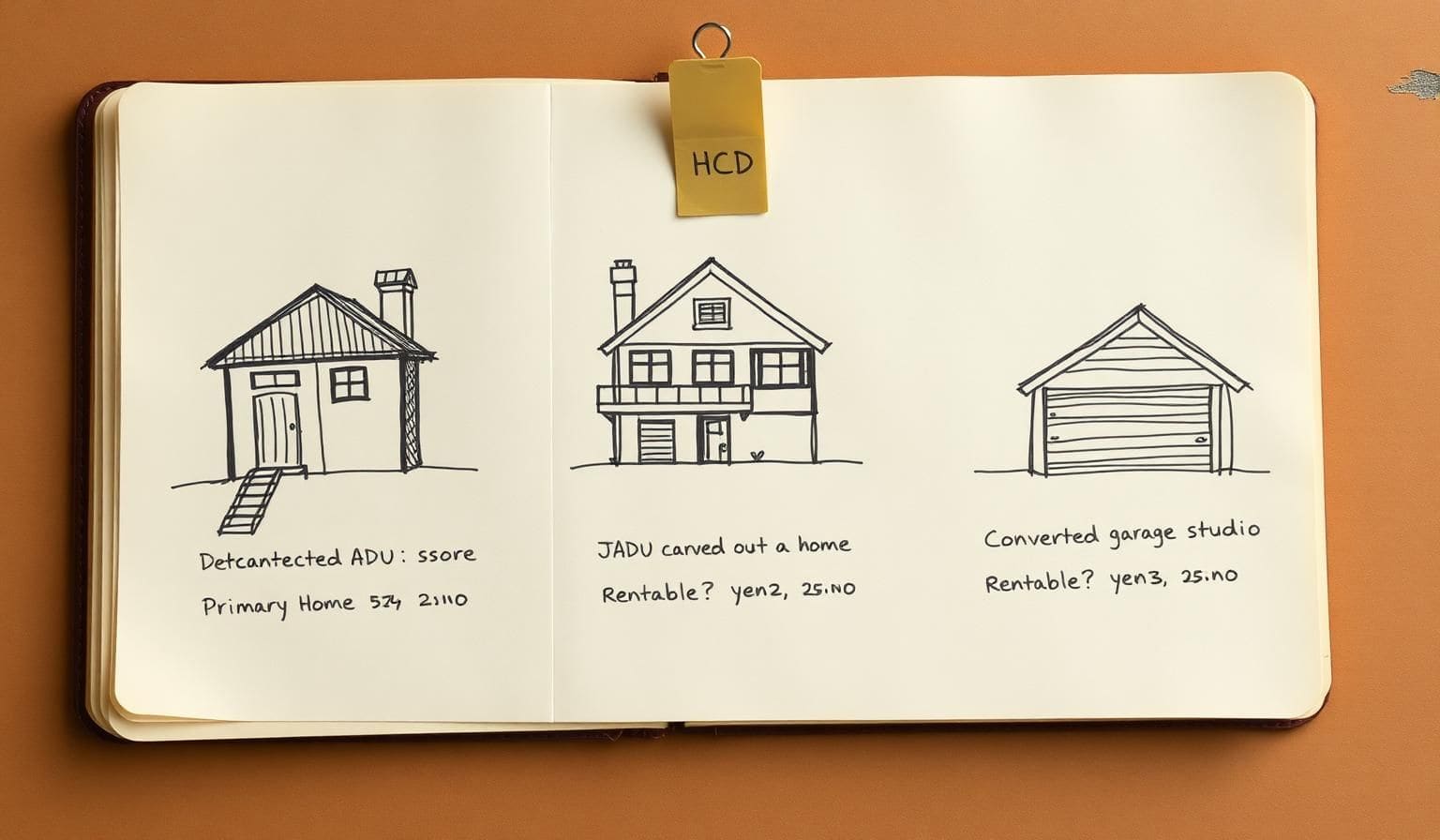
Many California homeowners reach for 'ADU' as the default answer for any backyard structure. It's often the wrong answer. If the goal is a home office, a $35K studio shed delivers it for a quarter of an ADU's cost. If the goal is a guest space for visiting family, a JADU carved from an existing main house delivers it without site work.
California's accessory-dwelling rules (HCD's ADU/JADU guidance is the authoritative reference California HCD ADU + JADU policy memos) actually offer four distinct structure types with very different cost, permit, and use profiles. Picking the right one matters more than picking a contractor.
Type 1: Accessory structure (no permit / minimal permit)
California Building Code allows one-story detached structures up to 120 sqft (typically) without a permit, provided no plumbing or hardwired electrical is installed. This is the 'tool shed' / 'pre-fab studio' category. Sheds from major retailers fall into this bucket.
Limitations: not legally habitable (no kitchen, no bathroom, no sleeping by code). Cannot be rented as a dwelling. Useful for storage, light hobby workshop, or unconditioned shelter only.
Type 2: Studio shed / accessory building (permit required)
121–500 sqft, often a single room with optional plumbing for a half-bath. Permit required (zoning compliance, building, electrical, plumbing if applicable). Often used as a home office, art studio, or guest space.
Permit cost: $2K–$6K. Construction: $200–$400/sqft for a quality build with insulation, HVAC, and electrical. Total for a 250 sqft studio: $55K–$110K. Not legally rentable as a separate dwelling but a useful home-office solution that adds appraisal value at resale.
Type 3: JADU — junior accessory dwelling unit
A JADU is carved from the existing footprint of the primary residence — typically an attached garage conversion or a master-suite conversion. Maximum 500 sqft, must include a small efficiency kitchen, shares the property's existing utilities and address. Owner of the property must occupy either the JADU or the main house.
Why JADU: typical cost $40K–$110K (you're working with existing walls, foundation, and utilities); fastest permit pathway under California law (ministerial review); rentable on long-term tenancies. Limitation: cannot be sold separately from the main house, and the owner-occupancy requirement is enforceable.
Type 4: Detached ADU
A full detached ADU is a separate dwelling, typically 600–1,200 sqft, with its own kitchen, bath, electrical service (or sub-panel), and separate address. Permit pathway under California law is ministerial for projects within the size and setback limits. HCD's ADU memos cover the controlling state rules California HCD ADU + JADU policy memos.
Cost: $250–$385/sqft in most California metros for new construction; garage conversions $145–$230/sqft. Rentable long-term; in most jurisdictions, also rentable as a long-term-only restriction (short-term rentals are restricted in many cities). Returns the highest rental yield and the highest appraisal add of the four types.
How to choose
Backyard office only, no overnight use: studio shed (Type 2). Rentable income unit on a small budget: JADU (Type 3). Long-term rental investment or multigenerational housing: detached ADU (Type 4). Storage / hobby space only: accessory structure (Type 1).
The single most expensive mistake we see: building a Type 2 studio shed and trying to retrofit it later into a Type 4 ADU. The permitting, foundation, and utility separation are all different — the retrofit usually costs more than building a new ADU from scratch.
Frequently asked
- Can I rent out a 'shed' or studio on Airbnb?
- No — short-term rentals require the structure to be legally habitable and most jurisdictions further require a Short-Term Rental permit. A non-habitable accessory structure cannot be legally rented, even short-term.
- Does a JADU require owner-occupancy?
- Yes. California law requires the property owner to occupy either the JADU or the primary residence on the parcel. The requirement is recorded as a deed restriction.
- Can I convert a Type 2 studio shed to an ADU later?
- Sometimes, but rarely cost-effective. The foundation, framing, utility separation, and Title 24 envelope are usually different for an ADU. Most owners who try this end up rebuilding.
- Where can I read more on ADU zoning after "Shed, studio, JADU, or full ADU? A California buyer's framework"?
- The pillar hub is the field journal — filter by the ADU zoning pillar. Definitions of the terms in this post live in the glossary.
- How does "Shed, studio, JADU, or full ADU? A California buyer's framework" translate to a real California project?
- See completed builds on the projects index, the full design-build sequence on the process page, and pricing bands in the 2026 California cost report.
- Which Alpha Dream studio covers my area for "Shed, studio, JADU, or full ADU? A California buyer's framework"?
- Los Angeles studio for LA, Orange, Inland Empire, and Ventura. Bay Area studio for SF, Peninsula, East Bay, South Bay, and North Bay.
- What's the fastest path from "Shed, studio, JADU, or full ADU? A California buyer's framework" to a quote?
- Run the ADU cost calculator for a band, then book a discovery call. We don't quote sight-unseen.
- Are the numbers in "Shed, studio, JADU, or full ADU? A California buyer's framework" verified against real bids?
- Yes — we publish from closed bids, not market averages. The full methodology is in the 2026 California cost report.
- Which California city does "Shed, studio, JADU, or full ADU? A California buyer's framework" apply best to?
- The post calls out its primary city; statewide context is on the locations index.
- Can I share "Shed, studio, JADU, or full ADU? A California buyer's framework" with my architect or designer?
- Yes — public content, attributable to Alpha Dream Construction. Pair it with the relevant field guides when you share.
- Does "Shed, studio, JADU, or full ADU? A California buyer's framework" replace a conversation with a contractor?
- No — it informs one. Book a discovery call to apply the post to your specific lot.
- Where do I find more posts on the same pillar as "Shed, studio, JADU, or full ADU? A California buyer's framework"?
- Filter by pillar on the field journal index. The topic clusters view groups posts with their related guides and city pages.
- Has the law changed since "Shed, studio, JADU, or full ADU? A California buyer's framework" was published?
- California ADU and remodel law shifts every session. Material changes get a new post on the journal; definitions update in the glossary.
- What's the related cost benchmark for "Shed, studio, JADU, or full ADU? A California buyer's framework"?
- See the 2026 cost report for city-by-city bands and the ADU cost calculator for an instant band.
- Can I cite "Shed, studio, JADU, or full ADU? A California buyer's framework" in a permit appeal or HOA letter?
- Yes — pair with the underlying statute. The permit directory links those sources.
Sources we cited
- 1.California HCD ADU + JADU policy memos — California HCD
- 2.California Building Standards Commission — California BSC
Referenced resources
Permit portals, fee bands, and code notes that back up the jurisdictions named in this article.
Related areas
Neighborhood guides that pair with this article — local code, lot patterns, and what we've actually built nearby.
Westside — ADU Zoning →
Local rules, costs, and project notes for Westside.
Area overview →San Fernando Valley — ADU Zoning →
Local rules, costs, and project notes for San Fernando Valley.
Area overview →San Gabriel Valley — ADU Zoning →
Local rules, costs, and project notes for San Gabriel Valley.
Area overview →