9 min read · updated 2026-05-18
How to finance an ADU in California (2026): HELOC, CalHFA, refi, cash
Five financing paths for a California ADU in 2026 — including the CalHFA $40K grant, construction-to-perm loans, HELOC, cash-out refi, and rental-income-supported underwriting.
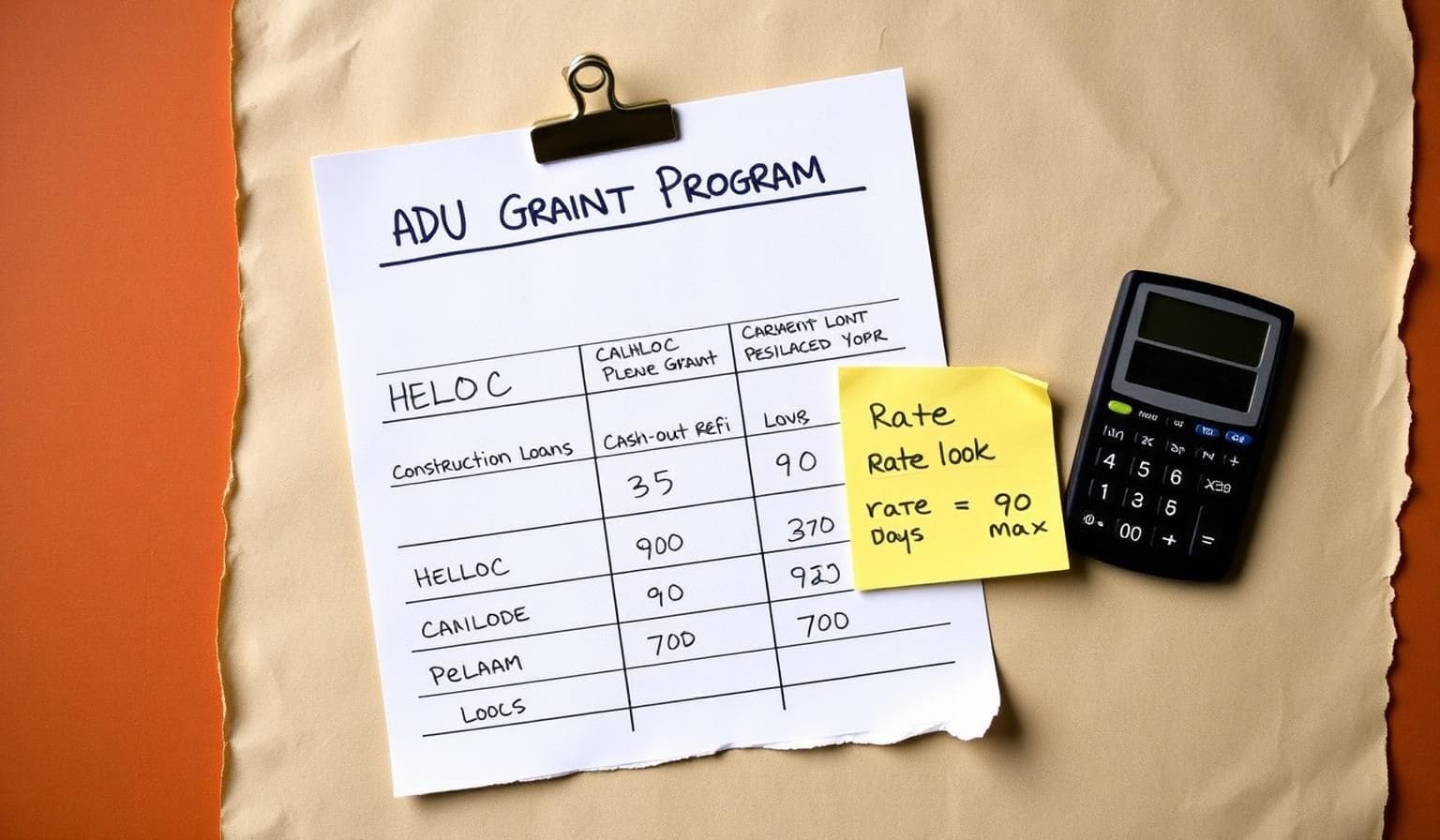
Five paths, ranked by typical use
We see five financing structures dominate California ADU work: HELOC, cash-out refinance, construction-to-permanent loan, RenoFi-style 'after-completion-value' loan, and cash. The right answer is driven by three variables: how much equity you have, how stable your income is, and how long you can carry the project before it produces rent.
The Mortgage Bankers Association tracks the rate environment that drives the math here MBA — mortgage rate environment research and Bankrate publishes useful product comparisons across lenders Bankrate — current HELOC and construction-loan products.
The CalHFA ADU Grant
CalHFA's ADU Grant Program — when funded — provides up to $40,000 to cover pre-development soft costs (plans, permits, surveys, soils, school fees, impact fees). It's a grant, not a loan; eligible homeowners don't repay it. Income limits and program rules change each round, so check the current notice before counting on it CalHFA ADU Grant Program.
The grant is most useful for owner-occupied projects where the soft costs would otherwise come out of the homeowner's savings before any construction starts. It does not cover hard construction costs.
HELOC vs. construction loan
A HELOC is fast (2–4 weeks to fund), cheap to originate, and floats with the prime rate. You draw against equity in the primary residence — typical limit is 80–85% combined LTV. Good for projects under $200K and for borrowers who plan to refinance into a fixed product once the ADU is rented.
A construction-to-permanent loan funds hard costs in draws against engineer-verified progress, then converts to a fixed mortgage at completion. Better for projects over $300K and for borrowers who want rate certainty. The downside: 60–90 day rate lock that routinely outlives California permit timelines.
Underwriting rental income from the planned ADU
Some lenders now allow projected ADU rental income to count toward the borrower's debt-to-income ratio — typically 75% of an appraiser-supported rent comparable. This is significant: a $3,200/mo ADU rent comp adds $2,400/mo to qualifying income.
Fannie Mae and Freddie Mac have published guidance allowing this on conforming loans for primary residences with ADUs — the appraiser must produce three rent comparables and the loan must be for refinance or purchase of the property where the ADU sits.
The rate-lock trap
We've watched a half-dozen LA projects get burned by this in the last 18 months: borrower locks a 90-day construction loan rate at submittal, plan check takes 14 weeks, and the project closes at whatever the market gives on day 91. Coastal, hillside, and HPOZ projects are particularly exposed.
Two defenses: lock late (after plan-check approval is in hand, not at submittal), or pay for an extended-lock product (typically 0.125%–0.375% in rate or 0.25% in points per extra 30 days). Either way, build the carry cost into the budget.
Frequently asked
- What credit score do I need?
- HELOC: usually 680+. Construction-to-perm: 700+. Some non-QM lenders go down to 660 with offsetting compensating factors (reserves, low DTI, large down payment).
- Can I roll soft costs into the loan?
- Construction-to-perm loans typically include soft costs in the funded amount; HELOC and cash-out refi pay them out of the draw at closing. CalHFA grant covers soft costs directly when eligible.
- How does the appraisal work for a property with a planned ADU?
- Most lenders order an 'as-completed' appraisal that values the property assuming the ADU is built per plans. The appraiser pulls comparable sales of similar properties with completed ADUs in the same submarket.
- Where can I read more on ADU financing after "How to finance an ADU in California (2026): HELOC, CalHFA, refi, cash"?
- The pillar hub is the field journal — filter by the ADU financing pillar. Definitions of the terms in this post live in the glossary.
- How does "How to finance an ADU in California (2026): HELOC, CalHFA, refi, cash" translate to a real California project?
- See completed builds on the projects index, the full design-build sequence on the process page, and pricing bands in the 2026 California cost report.
- Which Alpha Dream studio covers my area for "How to finance an ADU in California (2026): HELOC, CalHFA, refi, cash"?
- Los Angeles studio for LA, Orange, Inland Empire, and Ventura. Bay Area studio for SF, Peninsula, East Bay, South Bay, and North Bay.
- What's the fastest path from "How to finance an ADU in California (2026): HELOC, CalHFA, refi, cash" to a quote?
- Run the ADU cost calculator for a band, then book a discovery call. We don't quote sight-unseen.
- Are the numbers in "How to finance an ADU in California (2026): HELOC, CalHFA, refi, cash" verified against real bids?
- Yes — we publish from closed bids, not market averages. The full methodology is in the 2026 California cost report.
- Which California city does "How to finance an ADU in California (2026): HELOC, CalHFA, refi, cash" apply best to?
- The post calls out its primary city; statewide context is on the locations index.
- Can I share "How to finance an ADU in California (2026): HELOC, CalHFA, refi, cash" with my architect or designer?
- Yes — public content, attributable to Alpha Dream Construction. Pair it with the relevant field guides when you share.
- Does "How to finance an ADU in California (2026): HELOC, CalHFA, refi, cash" replace a conversation with a contractor?
- No — it informs one. Book a discovery call to apply the post to your specific lot.
- Where do I find more posts on the same pillar as "How to finance an ADU in California (2026): HELOC, CalHFA, refi, cash"?
- Filter by pillar on the field journal index. The topic clusters view groups posts with their related guides and city pages.
- Has the law changed since "How to finance an ADU in California (2026): HELOC, CalHFA, refi, cash" was published?
- California ADU and remodel law shifts every session. Material changes get a new post on the journal; definitions update in the glossary.
- What's the related cost benchmark for "How to finance an ADU in California (2026): HELOC, CalHFA, refi, cash"?
- See the 2026 cost report for city-by-city bands and the ADU cost calculator for an instant band.
- Can I cite "How to finance an ADU in California (2026): HELOC, CalHFA, refi, cash" in a permit appeal or HOA letter?
- Yes — pair with the underlying statute. The permit directory links those sources.
Sources we cited
- 1.MBA — mortgage rate environment research — Mortgage Bankers Association
- 2.Bankrate — current HELOC and construction-loan products — Bankrate
- 3.CalHFA ADU Grant Program — California Housing Finance Agency
- 4.California HCD ADU policy + financing memos — California HCD
- 5.Fannie Mae — ADU underwriting guidance — Fannie Mae
Referenced resources
Permit portals, fee bands, and code notes that back up the jurisdictions named in this article.
Related areas
Neighborhood guides that pair with this article — local code, lot patterns, and what we've actually built nearby.
Westside — ADU Cost →
Local rules, costs, and project notes for Westside.
Area overview →San Fernando Valley — ADU Cost →
Local rules, costs, and project notes for San Fernando Valley.
Area overview →San Gabriel Valley — ADU Cost →
Local rules, costs, and project notes for San Gabriel Valley.
Area overview →