9 min read · updated 2026-05-14
Kitchen remodel cost breakdown: California 2026
A line-item 2026 breakdown of a California kitchen remodel — cabinets, counters, appliances, electrical, plumbing, finishes. Where the money goes and where you can actually save.
What 'mid-range' actually means in California
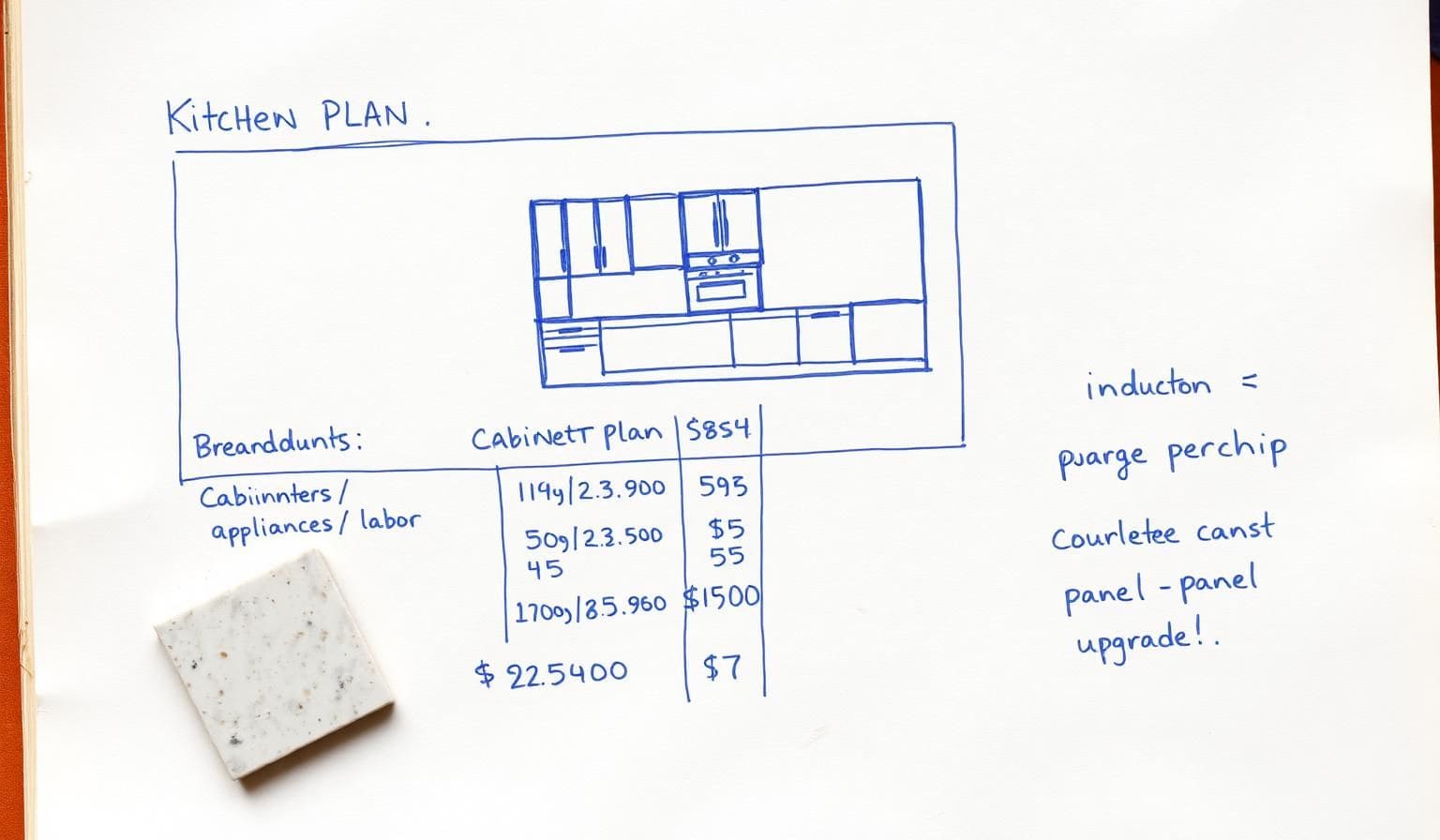
Mid-range California kitchen remodel, 2026: $70,000 to $140,000 all-in for a 150–220 sqft kitchen with custom or semi-custom cabinets, quartz counters, mid-tier appliance package (Bosch / KitchenAid / GE Profile), tile or wood flooring, and refreshed lighting + electrical. NAHB's national cost survey is a useful baseline for line-item percentages NAHB construction cost surveys.
Higher-end ($140K–$280K) adds full-custom cabinets, stone counters with waterfall island, professional appliance package (Wolf / Sub-Zero / Miele), and full structural work (wall removal, new openings). Budget-tier ($35K–$70K) is achievable with stock cabinets, laminate or solid-surface counters, and contractor-grade appliances.
The line-item percentages
On a $100K mid-range remodel, typical allocation: cabinets 30%, counters 11%, appliances 13%, electrical 8%, plumbing 6%, flooring 7%, drywall + paint 6%, tile / backsplash 4%, lighting 4%, demo + disposal 3%, general conditions / permit / GC overhead 8%.
Cabinets are the leverage point. The cost difference between a $20K stock cabinet package and a $40K semi-custom package is real, and so is the difference in box construction, drawer glides, and door alignment over a 20-year horizon. The cost difference between a $40K semi-custom and a $90K full-custom is mostly aesthetics — both will work fine for 30 years.
Title 24 on kitchen remodels
Three Title 24 triggers most kitchen remodels hit: ventilation (a code-compliant range hood is mandatory and the duct routing often forces a layout decision), lighting (high-efficacy LED is required and lighting controls have prescriptive requirements), and any window replacement (must meet current U-factor and SHGC). CEC's residential alterations guide is authoritative CEC Title 24 Part 6 (residential alterations).
These don't blow up the budget but they constrain the design. A $400 induction range that vents through a 6" round duct can be installed in places a $2,200 pro range with a 10" duct cannot.
Gas to induction (and the panel upgrade trap)
Switching from a gas range to induction adds a 240V/40A or 50A circuit. On a 200A panel with available capacity, that's a $400–$1,000 circuit. On a 100A panel that's already at 80% load with electric water heater or EV charger, it's a service upgrade — $3,000–$8,000 depending on whether the meter is replaced and whether trenching is involved.
Heat pump water heater + induction range + EV charger on a 100A panel is impossible without either a service upgrade or a smart load center (SPAN, Lumin) that manages the loads dynamically. Smart load centers cost $3,500–$6,000 installed and often pay back vs. a full service upgrade.
Where to actually save money
Three real savings levers: keep the existing footprint (moving plumbing and gas lines is the single biggest non-cabinet cost-amplifier), keep the existing window openings (new openings trigger structural and Title 24 work), and standardize on stock cabinet sizes from a semi-custom line (you get the box quality without the custom-modification surcharge).
False savings to avoid: stock cabinets installed by a custom-cabinet GC (you pay for the labor without the value), contractor-grade appliances that look identical to mid-range on day one but rattle apart in year three, and any quartz that's priced below $35/sqft installed (almost always a thin sheet bonded to MDF — it chips at every edge).
Frequently asked
- How long does a typical kitchen remodel take?
- Design + permit + procurement: 8–14 weeks. Construction: 6–10 weeks for a mid-range remodel keeping the footprint, 10–16 weeks if walls move or structural work is involved.
- Do I need a permit?
- Yes for any project that moves plumbing, gas, electrical, or structural. Cabinet replacement alone may not require a permit but most contractors pull one regardless to avoid future title issues.
- Will a kitchen remodel return its cost at resale?
- Mid-range remodels in California metros typically return 65–85% of cost at resale per Remodeling Magazine's annual Cost vs. Value report — the rest of the value is in years of use before sale.
- Where can I read more on ADU cost after "Kitchen remodel cost breakdown: California 2026"?
- The pillar hub is the field journal — filter by the ADU cost pillar. Definitions of the terms in this post live in the glossary.
- How does "Kitchen remodel cost breakdown: California 2026" translate to a real California project?
- See completed builds on the projects index, the full design-build sequence on the process page, and pricing bands in the 2026 California cost report.
- Which Alpha Dream studio covers my area for "Kitchen remodel cost breakdown: California 2026"?
- Los Angeles studio for LA, Orange, Inland Empire, and Ventura. Bay Area studio for SF, Peninsula, East Bay, South Bay, and North Bay.
- What's the fastest path from "Kitchen remodel cost breakdown: California 2026" to a quote?
- Run the ADU cost calculator for a band, then book a discovery call. We don't quote sight-unseen.
- Are the numbers in "Kitchen remodel cost breakdown: California 2026" verified against real bids?
- Yes — we publish from closed bids, not market averages. The full methodology is in the 2026 California cost report.
- Which California city does "Kitchen remodel cost breakdown: California 2026" apply best to?
- The post calls out its primary city; statewide context is on the locations index.
- Can I share "Kitchen remodel cost breakdown: California 2026" with my architect or designer?
- Yes — public content, attributable to Alpha Dream Construction. Pair it with the relevant field guides when you share.
- Does "Kitchen remodel cost breakdown: California 2026" replace a conversation with a contractor?
- No — it informs one. Book a discovery call to apply the post to your specific lot.
- Where do I find more posts on the same pillar as "Kitchen remodel cost breakdown: California 2026"?
- Filter by pillar on the field journal index. The topic clusters view groups posts with their related guides and city pages.
- Has the law changed since "Kitchen remodel cost breakdown: California 2026" was published?
- California ADU and remodel law shifts every session. Material changes get a new post on the journal; definitions update in the glossary.
- What's the related cost benchmark for "Kitchen remodel cost breakdown: California 2026"?
- See the 2026 cost report for city-by-city bands and the ADU cost calculator for an instant band.
- Can I cite "Kitchen remodel cost breakdown: California 2026" in a permit appeal or HOA letter?
- Yes — pair with the underlying statute. The permit directory links those sources.
Sources we cited
- 1.NAHB construction cost surveys — National Association of Home Builders
- 2.CEC Title 24 Part 6 (residential alterations) — California Energy Commission
- 3.LADBS permit fee schedule — LADBS
Related areas
Neighborhood guides that pair with this article — local code, lot patterns, and what we've actually built nearby.