8 min read · updated 2026-04-22
Prefab vs site-built ADUs: honest tradeoffs
Modular and panelized ADUs promise speed and cost certainty. Here's where the promises hold up in LA, and where the math quietly breaks down.
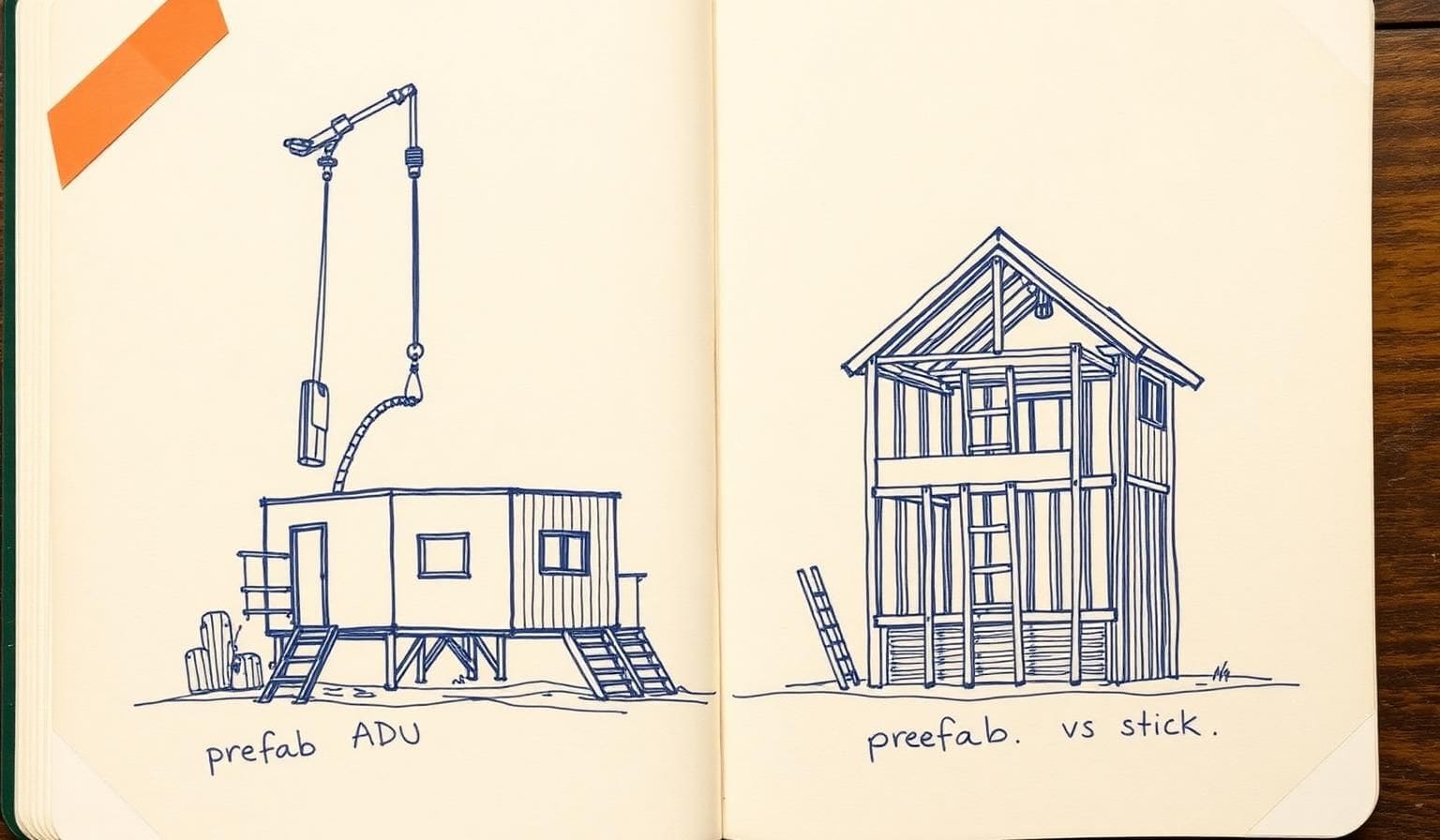
Three different things people call 'prefab'
True modular: full 3D box modules built in a factory, trucked to site, craned into place. Panelized: flat 2D wall and floor panels built in a factory, assembled on site. Pre-cut/pre-engineered: components cut and labeled in a factory, framed conventionally on site. Each has a different LA cost profile.
Fine Homebuilding has good coverage of the technical distinctions Fine Homebuilding — prefab construction coverage and JLC's commercial-grade construction reporting JLC — construction supply chain reporting is useful for understanding the supply-chain economics.
What full modular actually saves
Hard cost savings of 5–15% are realistic for full modular ADUs in LA, driven by factory labor productivity and bulk material purchasing. Schedule compression on the structure itself is real — a modular ADU can be set in a single day after months of factory build time.
What modular doesn't save: foundation construction, utility hookups, finish work like decks and landscaping, and permits. The Terner Center has published research on California modular adoption Terner Center — California modular research and the LA Times has covered local modular ADU projects LA Times — modular ADU coverage.
Where modular loses on LA lots
Crane access. Many LA lots — Westside flats, hillside, narrow Eastside parcels — cannot accommodate the crane swing radius needed to set a modular ADU. The crane logistics ($8,000–$25,000 just for the crane day, more for street closures) frequently erase the factory savings.
Site-built construction also produces a more customized result. Modular ADUs tend toward standard floor plans because the factory tooling is the constraint. ArchDaily's coverage of modular vs site-built tradeoffs is worth reading ArchDaily — modular vs site-built and Dwell has good case studies of both Dwell — prefab and site-built case studies.
Panelized: the underrated middle path
Panelized construction (2D wall panels assembled on site, no crane needed) gets most of the factory-precision benefit without the crane logistics. Panels arrive on a flatbed truck, get carried into the backyard, and are stood up by a small framing crew. For LA lots with poor crane access, panelized often pencils better than either pure modular or pure stick-build.
Curbed LA has reported on panelized ADU adoption in LA neighborhoods Curbed LA — panelized ADU adoption and ArchDaily covers the design implications well ArchDaily — panelized residential.
How to evaluate a prefab quote
Make sure the quote includes: foundation, crane day(s), site prep, utility connections, finish carpentry, exterior decking and entry stairs, landscaping restoration, and contingency. Many prefab marketing prices exclude all of these — the bare module price is often only 55–65% of the actual project cost.
Compare apples to apples by getting a site-built quote on the same scope from a local contractor and looking at total project cost, not module cost. Maxable maintains good comparisons Maxable — prefab comparison guides and AARP's small-footprint home guides are useful for spec definition AARP — small-footprint home guides.
Frequently asked
- How much faster is prefab really?
- From contract to occupancy, modular saves 6–10 weeks vs site-built on a clean project. Permit and site prep timelines are unchanged. The factory build often happens in parallel with permitting, which is where the perceived speed comes from.
- Is prefab quality better or worse?
- Factory-built panels are produced under controlled conditions and inspected at each stage — that's a quality advantage. The risk surface is in the site connections, transport handling, and finish work, where modular and site-built converge.
- Can I get a modular ADU on a hillside lot?
- Sometimes — but the crane requirement and the hillside foundation requirement frequently combine to make modular cost-uncompetitive. Most LA hillside ADUs end up site-built or panelized.
- Where can I read more on ADU design after "Prefab vs site-built ADUs: honest tradeoffs"?
- The pillar hub is the field journal — filter by the ADU design pillar. Definitions of the terms in this post live in the glossary.
- How does "Prefab vs site-built ADUs: honest tradeoffs" translate to a real California project?
- See completed builds on the projects index, the full design-build sequence on the process page, and pricing bands in the 2026 California cost report.
- Which Alpha Dream studio covers my area for "Prefab vs site-built ADUs: honest tradeoffs"?
- Los Angeles studio for LA, Orange, Inland Empire, and Ventura. Bay Area studio for SF, Peninsula, East Bay, South Bay, and North Bay.
- What's the fastest path from "Prefab vs site-built ADUs: honest tradeoffs" to a quote?
- Run the ADU cost calculator for a band, then book a discovery call. We don't quote sight-unseen.
- Are the numbers in "Prefab vs site-built ADUs: honest tradeoffs" verified against real bids?
- Yes — we publish from closed bids, not market averages. The full methodology is in the 2026 California cost report.
- Which California city does "Prefab vs site-built ADUs: honest tradeoffs" apply best to?
- The post calls out its primary city; statewide context is on the locations index.
- Can I share "Prefab vs site-built ADUs: honest tradeoffs" with my architect or designer?
- Yes — public content, attributable to Alpha Dream Construction. Pair it with the relevant field guides when you share.
- Does "Prefab vs site-built ADUs: honest tradeoffs" replace a conversation with a contractor?
- No — it informs one. Book a discovery call to apply the post to your specific lot.
- Where do I find more posts on the same pillar as "Prefab vs site-built ADUs: honest tradeoffs"?
- Filter by pillar on the field journal index. The topic clusters view groups posts with their related guides and city pages.
- Has the law changed since "Prefab vs site-built ADUs: honest tradeoffs" was published?
- California ADU and remodel law shifts every session. Material changes get a new post on the journal; definitions update in the glossary.
- What's the related cost benchmark for "Prefab vs site-built ADUs: honest tradeoffs"?
- See the 2026 cost report for city-by-city bands and the ADU cost calculator for an instant band.
- Can I cite "Prefab vs site-built ADUs: honest tradeoffs" in a permit appeal or HOA letter?
- Yes — pair with the underlying statute. The permit directory links those sources.
Sources we cited
- 1.Fine Homebuilding — prefab construction coverage — Fine Homebuilding
- 2.JLC — construction supply chain reporting — JLC Online
- 3.Terner Center — California modular research — UC Berkeley Terner Center
- 4.LA Times — modular ADU coverage — Los Angeles Times
- 5.ArchDaily — modular vs site-built — ArchDaily
- 6.Dwell — prefab and site-built case studies — Dwell
- 7.Curbed LA — panelized ADU adoption — Curbed Los Angeles
- 8.ArchDaily — panelized residential — ArchDaily
- 9.Maxable — prefab comparison guides — Maxable
- 10.AARP — small-footprint home guides — AARP
Related areas
Neighborhood guides that pair with this article — local code, lot patterns, and what we've actually built nearby.
San Fernando Valley — ADU Cost →
Local rules, costs, and project notes for San Fernando Valley.
Area overview →San Gabriel Valley — ADU Cost →
Local rules, costs, and project notes for San Gabriel Valley.
Area overview →South Bay — ADU Cost →
Local rules, costs, and project notes for South Bay.
Area overview →Orange County — ADU Cost →
Local rules, costs, and project notes for Orange County.
Area overview →Inland Empire — ADU Cost →
Local rules, costs, and project notes for Inland Empire.
Area overview →