10 min read · updated 2026-05-22
Bay Area foundation repair: a fault-proximity buyer's guide
What every Bay Area homeowner should know about the Hayward, San Andreas, and Calaveras faults — and how proximity changes foundation diagnosis, repair scope, and insurance.
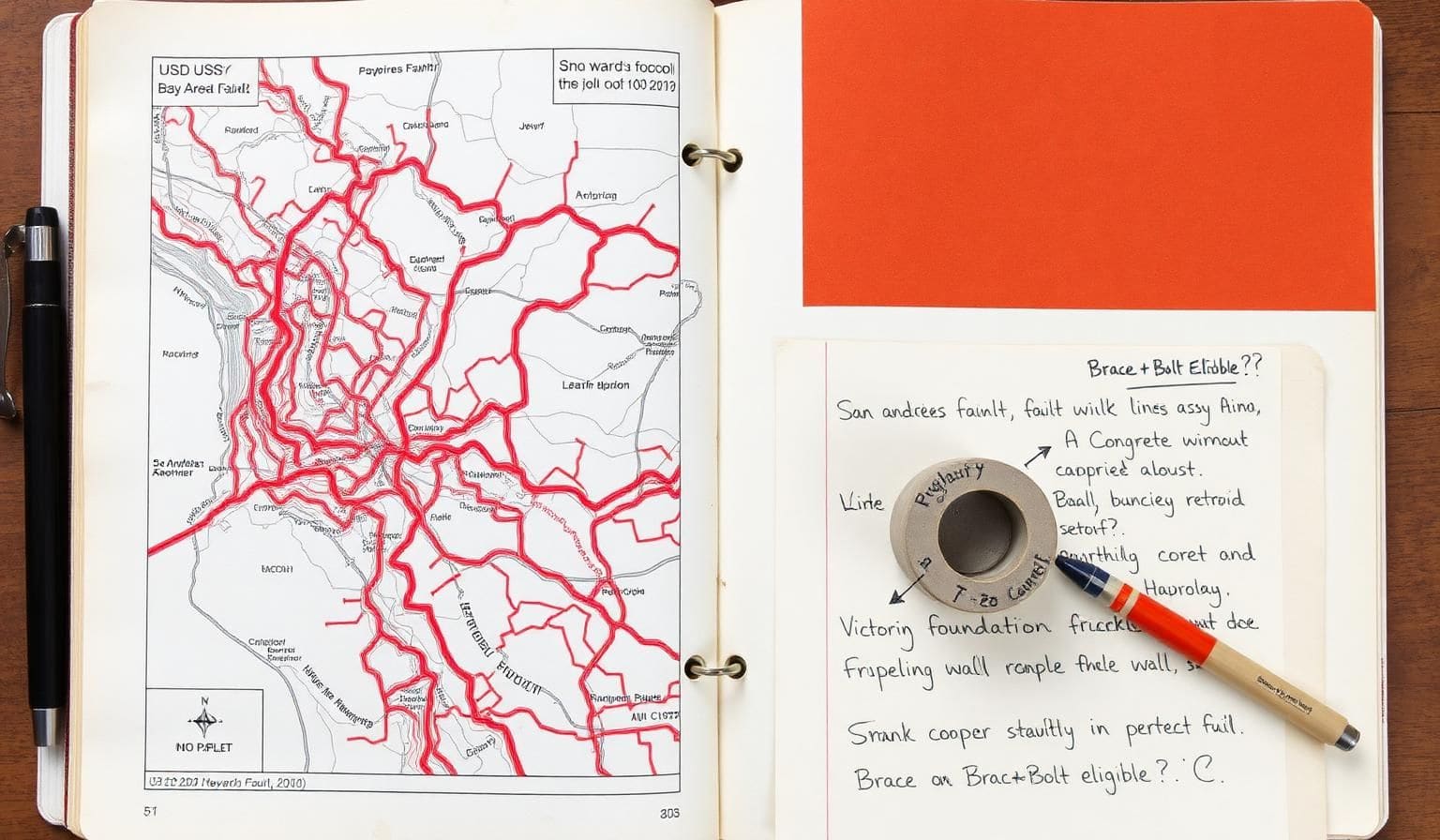
The three faults that matter most
The San Andreas runs along the Peninsula and into San Mateo and Santa Clara counties. The Hayward runs through the East Bay urban core — Oakland, Berkeley, Hayward, Fremont — and is the fault most seismologists watch most closely for a near-term rupture. The Calaveras runs further east through the Tri-Valley and East Bay foothills. USGS publishes the authoritative fault maps and probability studies USGS Quaternary Fault and Fold Database.
For foundation work the distinction matters: proximity to a known active fault drives both the diagnostic (what's already failed and why) and the retrofit spec (what we add for the next event).
Pre-1980 wood-frame: the dominant failure mode
Most pre-1980 Bay Area single-family homes share a vulnerability: the wood framing of the house is not positively anchored to the concrete foundation, and the short stub-wall between the foundation and the first floor (the 'cripple wall') is unbraced. In strong shaking the house slides off, the cripple wall collapses, or both.
Two repairs together close most of this exposure: sill-plate anchor bolting (drilling and epoxy-anchoring bolts through the sill into the foundation) and cripple-wall sheathing (plywood applied to the inside of the cripple wall with engineered nailing). FEMA P-1100 is the standard prescriptive guide for one- and two-family wood-frame retrofits FEMA P-1100 (residential retrofit guide).
When the foundation itself is the problem
Older Bay Area foundations come in three flavors: unreinforced brick perimeter (pre-1930), unreinforced concrete (1920s–1940s), and reinforced concrete (post-1940s). Unreinforced brick and unreinforced concrete cannot be brought to current code through retrofit alone — they need replacement, typically a full perimeter foundation replacement in stages while the house is supported on cribs.
Replacement runs $80,000–$220,000 for most Bay Area single-family homes, driven mostly by access (hillside sites cost more) and by what's on the floor above (a finished basement adds shoring complexity).
Soft-story ordinances by city
San Francisco's Mandatory Soft-Story Program covers wood-frame buildings of 3+ stories with 5+ residential units containing a soft, weak, or open-front ground story. SF DBI runs the program SF DBI Mandatory Soft-Story Program. Oakland's program (Chapter 15.27) covers similar buildings and Berkeley has its own. Each program has different thresholds and deadlines — confirm against the city, not generic resources.
The CEA Brace + Bolt grant
The California Earthquake Authority's Brace + Bolt program provides up to $3,000 toward eligible cripple-wall + sill-plate retrofits for owner-occupied homes built before 1980 in qualifying zip codes California Earthquake Authority Brace + Bolt program. The grant pays through a participating contractor and requires program-approved work.
For a typical $7K–$12K retrofit on a small bungalow, the grant covers 25–40% of cost. For larger homes the retrofit cost scales up but the grant cap doesn't.
Frequently asked
- How do I know if my house is bolted?
- Look in the crawlspace at the sill plate (the bottom wood member sitting on the foundation). If you see hex-headed bolts every 4–6 ft going through the wood into the concrete, it has been retrofitted. If you see only nails (or nothing), it likely has not.
- Does earthquake insurance require a retrofit?
- CEA does not require a retrofit but offers a Hazard Reduction Discount of up to 25% for qualifying retrofit work documented by a participating contractor or licensed engineer.
- How long does a typical retrofit take?
- Sill-plate bolting + cripple-wall sheathing on a 1,200 sqft single-story bungalow: 2–4 working days. Larger homes or homes with finished crawlspaces take longer.
- Where can I read more on ADU design after "Bay Area foundation repair: a fault-proximity buyer's guide"?
- The pillar hub is the field journal — filter by the ADU design pillar. Definitions of the terms in this post live in the glossary.
- How does "Bay Area foundation repair: a fault-proximity buyer's guide" translate to a real California project?
- See completed builds on the projects index, the full design-build sequence on the process page, and pricing bands in the 2026 California cost report.
- Which Alpha Dream studio covers my area for "Bay Area foundation repair: a fault-proximity buyer's guide"?
- Los Angeles studio for LA, Orange, Inland Empire, and Ventura. Bay Area studio for SF, Peninsula, East Bay, South Bay, and North Bay.
- What's the fastest path from "Bay Area foundation repair: a fault-proximity buyer's guide" to a quote?
- Run the ADU cost calculator for a band, then book a discovery call. We don't quote sight-unseen.
- Are the numbers in "Bay Area foundation repair: a fault-proximity buyer's guide" verified against real bids?
- Yes — we publish from closed bids, not market averages. The full methodology is in the 2026 California cost report.
- Which California city does "Bay Area foundation repair: a fault-proximity buyer's guide" apply best to?
- The post calls out its primary city; statewide context is on the locations index.
- Can I share "Bay Area foundation repair: a fault-proximity buyer's guide" with my architect or designer?
- Yes — public content, attributable to Alpha Dream Construction. Pair it with the relevant field guides when you share.
- Does "Bay Area foundation repair: a fault-proximity buyer's guide" replace a conversation with a contractor?
- No — it informs one. Book a discovery call to apply the post to your specific lot.
- Where do I find more posts on the same pillar as "Bay Area foundation repair: a fault-proximity buyer's guide"?
- Filter by pillar on the field journal index. The topic clusters view groups posts with their related guides and city pages.
- Has the law changed since "Bay Area foundation repair: a fault-proximity buyer's guide" was published?
- California ADU and remodel law shifts every session. Material changes get a new post on the journal; definitions update in the glossary.
- What's the related cost benchmark for "Bay Area foundation repair: a fault-proximity buyer's guide"?
- See the 2026 cost report for city-by-city bands and the ADU cost calculator for an instant band.
- Can I cite "Bay Area foundation repair: a fault-proximity buyer's guide" in a permit appeal or HOA letter?
- Yes — pair with the underlying statute. The permit directory links those sources.
Sources we cited
Referenced resources
Permit portals, fee bands, and code notes that back up the jurisdictions named in this article.
Related areas
Neighborhood guides that pair with this article — local code, lot patterns, and what we've actually built nearby.