8 min read · updated 2026-05-19
Cool-roof compliance in Southern California: Title 24's prescriptive path explained
Southern California climate zones 8–15 require cool-roof products on most low-slope reroofs and many steep-slope replacements. Here's how SRI, CRRC ratings, and the prescriptive path actually work.
Which projects trigger cool-roof
Title 24 Part 6 §150.2 covers residential additions and alterations. Reroofs that replace more than 50% of the roof surface (the typical 'full reroof' scenario) trigger cool-roof compliance in most Southern California climate zones for low-slope roofs and in CZ 10–15 for steep-slope roofs. The CEC publishes the controlling standards CEC Title 24 Part 6 (cool-roof provisions).
Repairs under the 50% threshold and overlay-only work (where allowed by jurisdiction) typically do not trigger cool-roof — but the threshold is enforced strictly, and a 'partial reroof' that actually replaces 60% of the surface will be flagged at inspection.
SRI, reflectance, emittance — what the numbers mean
Three ratings matter: Solar Reflectance (SR, 0 to 1) — how much sunlight the roof reflects vs. absorbs; Thermal Emittance (E, 0 to 1) — how readily the roof releases absorbed heat; Solar Reflectance Index (SRI) — a composite metric (0 to 100+) that combines the two. All three are tested and rated by the CRRC Cool Roof Rating Council product database.
Title 24 prescriptive path requires minimums depending on slope and climate zone. For low-slope in most CZ: aged SR ≥ 0.63 and thermal emittance ≥ 0.75. For steep-slope CZ 10–15: aged SR ≥ 0.20 and thermal emittance ≥ 0.75. 'Aged' values matter — initial ratings are not what the code references.
Cool-roof options by material
Single-ply membranes (TPO, PVC): nearly all are cool-roof rated by default. TPO white has aged SR 0.68+ and dominates new low-slope work. PVC has similar ratings and better chemical resistance.
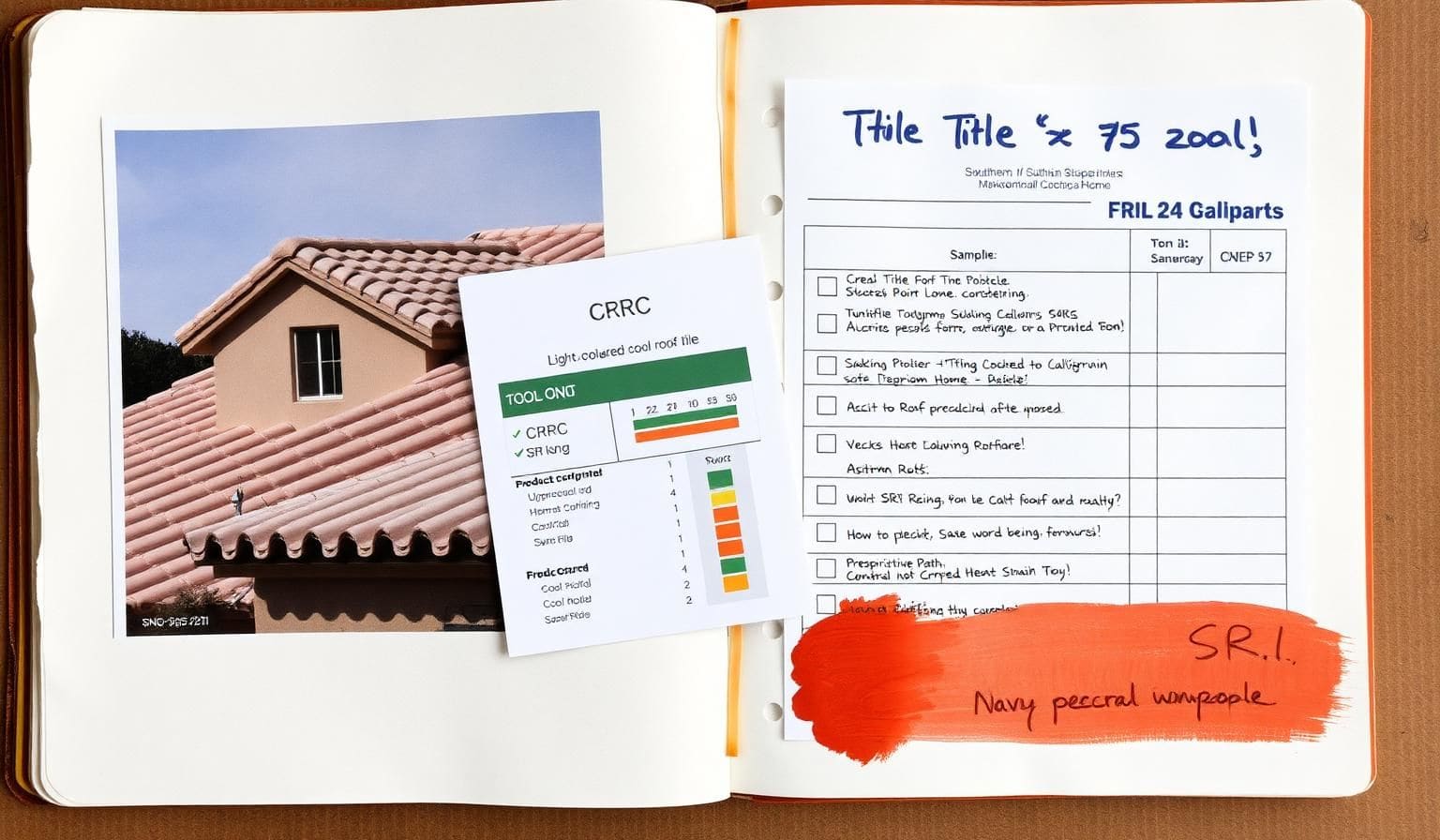
Tile (clay, concrete): light-colored tile typically meets steep-slope cool-roof requirements. Most major tile manufacturers list multiple SKUs with CRRC ratings on their websites.
Asphalt shingle: traditional shingles do not meet cool-roof minimums; specifically formulated cool-shingles (GAF Timberline Cool Series, CertainTeed Landmark Solaris) are available and meet steep-slope requirements.
Metal: standing-seam in light colors with cool-pigment coatings is typically compliant; bare metal or galvalume often is not (high reflectance but low emittance trips the composite SRI calculation).
Prescriptive vs. performance path
Prescriptive path: pick a CRRC-rated product that meets the minimums for your slope and climate zone. Document with the CRRC product ID at permit. Simple, fast, low risk.
Performance path: use whole-building energy modeling to demonstrate the project meets the energy budget despite a non-compliant roof. Requires a CEC-approved modeling tool (CBECC-Res), a HERS rater for verification, and offsetting upgrades elsewhere in the building. Usually only worth it on whole-house remodels with significant other envelope work.
What about rebates and resale
LADWP, SCE, and SoCalGas have run cool-roof rebate programs intermittently — confirm current funding before counting on it. The federal IRA Section 25C energy-efficient home improvement credit covers some cool-roof work as part of a broader envelope upgrade.
Resale impact is real but modest. Buyers in cooling-dominated CZ 10–15 increasingly ask about roof age and color; a 5–10 year old cool roof is a defensible value-add at appraisal.
Frequently asked
- Can I use a dark roof if I add solar?
- On the performance path, yes — adding PV capacity can offset a non-compliant roof. On the prescriptive path, no — the roof must meet its own minimums regardless of solar.
- Do tile roofs need cool-roof rating?
- In CZ 10–15 for steep-slope, yes. Most light and medium-light tiles meet aged SR ≥ 0.20 with high thermal emittance. Dark earth-tone tiles may require specifically rated SKUs.
- What happens at inspection if my product isn't CRRC-rated?
- Either rework to a compliant product, or switch to the performance path with a CBECC-Res model and a HERS rater. Both options cost more than choosing compliant from the start.
- Where can I read more on ADU permits after "Cool-roof compliance in Southern California: Title 24's prescriptive path explained"?
- The pillar hub is the field journal — filter by the ADU permits pillar. Definitions of the terms in this post live in the glossary.
- How does "Cool-roof compliance in Southern California: Title 24's prescriptive path explained" translate to a real California project?
- See completed builds on the projects index, the full design-build sequence on the process page, and pricing bands in the 2026 California cost report.
- Which Alpha Dream studio covers my area for "Cool-roof compliance in Southern California: Title 24's prescriptive path explained"?
- Los Angeles studio for LA, Orange, Inland Empire, and Ventura. Bay Area studio for SF, Peninsula, East Bay, South Bay, and North Bay.
- What's the fastest path from "Cool-roof compliance in Southern California: Title 24's prescriptive path explained" to a quote?
- Run the ADU cost calculator for a band, then book a discovery call. We don't quote sight-unseen.
- Are the numbers in "Cool-roof compliance in Southern California: Title 24's prescriptive path explained" verified against real bids?
- Yes — we publish from closed bids, not market averages. The full methodology is in the 2026 California cost report.
- Which California city does "Cool-roof compliance in Southern California: Title 24's prescriptive path explained" apply best to?
- The post calls out its primary city; statewide context is on the locations index.
- Can I share "Cool-roof compliance in Southern California: Title 24's prescriptive path explained" with my architect or designer?
- Yes — public content, attributable to Alpha Dream Construction. Pair it with the relevant field guides when you share.
- Does "Cool-roof compliance in Southern California: Title 24's prescriptive path explained" replace a conversation with a contractor?
- No — it informs one. Book a discovery call to apply the post to your specific lot.
- Where do I find more posts on the same pillar as "Cool-roof compliance in Southern California: Title 24's prescriptive path explained"?
- Filter by pillar on the field journal index. The topic clusters view groups posts with their related guides and city pages.
- Has the law changed since "Cool-roof compliance in Southern California: Title 24's prescriptive path explained" was published?
- California ADU and remodel law shifts every session. Material changes get a new post on the journal; definitions update in the glossary.
- What's the related cost benchmark for "Cool-roof compliance in Southern California: Title 24's prescriptive path explained"?
- See the 2026 cost report for city-by-city bands and the ADU cost calculator for an instant band.
- Can I cite "Cool-roof compliance in Southern California: Title 24's prescriptive path explained" in a permit appeal or HOA letter?
- Yes — pair with the underlying statute. The permit directory links those sources.
Sources we cited
- 1.CEC Title 24 Part 6 (cool-roof provisions) — California Energy Commission
- 2.Cool Roof Rating Council product database — CRRC
Referenced resources
Permit portals, fee bands, and code notes that back up the jurisdictions named in this article.
Related areas
Neighborhood guides that pair with this article — local code, lot patterns, and what we've actually built nearby.
Westside — ADU Permits →
Local rules, costs, and project notes for Westside.
Area overview →San Fernando Valley — ADU Permits →
Local rules, costs, and project notes for San Fernando Valley.
Area overview →Inland Empire — ADU Permits →
Local rules, costs, and project notes for Inland Empire.
Area overview →